Is India a Good Place to Study for International Students? (Honest Review 2026)
Authored by Dr. Meera Krishnan, Analyst for University Rankings and Programs | Most recent update: June 08, 2026
Is India Worth It for International Students? The Short Answer
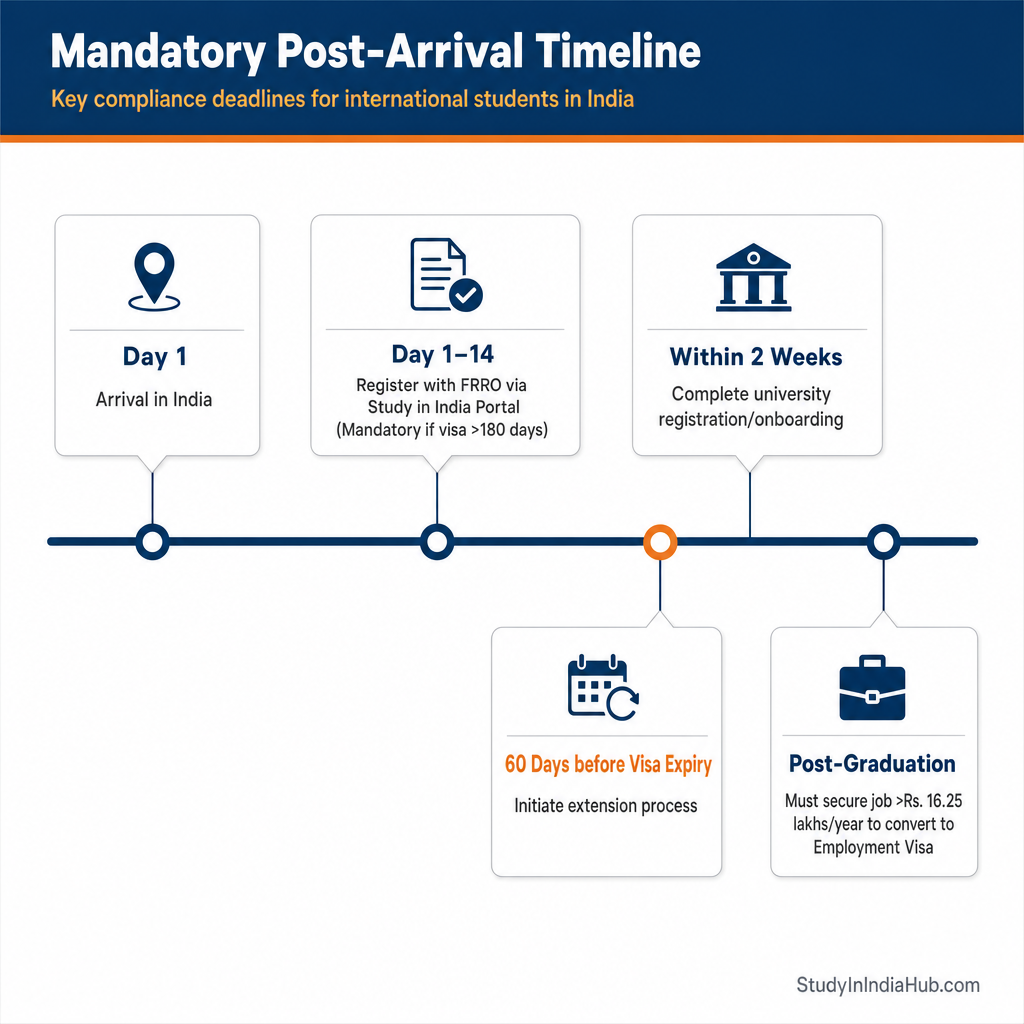
Indeed, India is worthwhile, but solely for the appropriate discipline, the right institution, and a budget of approximately $15,000–$25,000 annually. If you are considering studying in India, the most favorable results arise in engineering, IT, business, and sciences at leading universities. IIT Bombay is placed 3rd in engineering. Hostel and mess charges range between ₹1,000–₹3,000 each month. The majority of classes are conducted in English. You are also entering one of the globe's rapidly expanding economies. The compromise is genuine. Quality varies greatly between prestigious universities and lesser-known institutions. Therefore, check the department, not merely the country. You must also register with FRRO within 14 days of your arrival if your visa exceeds 180 days (Study in India Portal). The true question is not if India is valuable. It's about your particular program at your particular university.
[IMAGE PLACEHOLDER: IIT Bombay campus with international students walking between modern lab buildings]
India by the Numbers: Who Studies There and Why
As of 2022, India accommodates 46,878 international students from 170 different countries (Study in India). You wouldn't enter a vacant space. Approximately 28% of those students are distributed among universities and colleges. That indicates to me the ecosystem is genuine, not just a marketing assertion. A single note regarding the data. The sources indicate there are no annual growth rates. Consider the headline figure as a moment in time, rather than a trend over time. Enrollment fell significantly during the 2020–2021 pandemic. It bounced back as frontiers were reopened. Growth has remained consistent since 2022. The majority of it originates from students in Nepal, Afghanistan, Bangladesh, and various African countries. The trend indicates a rebound, rather than a singular surge. The location where students congregate is more significant than the overall figure. Savitribai Phule Pune University (SPPU) accommodates approximately 10,000 to 14,000 international students from over 100 nations (SPPU International Centre). That is among the most profound international clusters in the nation. The majority of students in that area originate from adjacent regions and the Middle East.
For admissions, country-specific recognition matters more than general hype:
| Student Origin | Entry/Equivalency Requirement |
|---|---|
| Nepal | No visa required; only university registration |
| Bangladesh | HSC recognized as equivalent to Indian Class 12 |
| UAE | Secondary Certificate recognized; CBSE/IB accepted directly |
| Kuwait | Thanawiya Amma requires AIU equivalency |
Policy is also changing. The National Education Policy (NEP) 2020 establishes a target of 50% Gross Enrolment Ratio by 2035. It also allows the top 100 international universities to establish campuses in India. One fact I always highlight. Post-study work opportunities are restricted compared to Western locations. The majority of students intend to go back home or relocate after completing their studies.
The Pros of Studying in India
India's major advantages include affordability, brand reputation, and robust initiatives in particular areas. The most obvious advantage is the difference in tuition.
The Cost Gap Is the Headline
Engineering fees at Vellore Institute of Technology (VIT) are US$3,000–5,000 annually for international students enrolled in B. Tech programs (VIT). That’s a portion of the US$30,000–40,000 average annual cost for international engineering undergraduates in the US. For similar 2-year master's programs such as an MBA or MSc, mid-tier Indian options are about one-fourth to one-fifth the cost of UK tuition for the 2025–2026 cycle. Medicine and pharmacy are even more precise. Government subsidies maintain tuition under US$1,000 annually (Study in India). One warning: check the current fee with the institution directly. The difference between a subsidized seat and a full-fee category is difficult to notice.
| Program area | India | Comparison point |
|---|---|---|
| 2-year postgraduate (MBA/MSc) | 1/4–1/5 of UK cost | Mid-tier India, 2025–2026 |
| Medicine / Pharmacy | < US$1,000/year | Government-subsidized (Study in India) |
| B. Tech at VIT (foreign nationals) | US$3,000–5,000/year | (VIT) |
| International engineering undergrad, US | US$30,000–40,000/year | — |
Brand Names and Placement Records
The Indian Institutes of Management (IIMs) and the Indian School of Business (ISB) post placement rates near 100% within 3 months most years. Graduates from IIT Bombay, ranked #3 nationally (NIRF 2024) and #118 globally (QS 2025): move into multinationals, startups, and research roles. IIT Bombay and JNU both hold A++ NAAC accreditation (NAAC).
The "global brand" premium is uneven, though. Look at the institute, not the country name. India is especially credible in engineering, medicine, IT, and business.
Visa, Logistics, and Immersion
The S-1 student visa is solely based on documents. It contains no official interview (Study in India). Your offer of admission, proof of finances, and university documentation hold significance. The Study in India portal manages your FRRO compliance during registration. Air India, IndiGo, and SpiceJet operate as many as 70 flights weekly from key hubs. For students from nearby areas, it's easier. Nepali nationals can enter India without a visa. They only require a student permit or university enrollment.Most major universities offer English-medium programs. The cultural experience is genuine. Learning in a vast, varied, rapidly growing economy enhances adaptability. You acquire skills to tackle challenges across languages, areas, and limited finances. Those abilities translate directly into collaborative team efforts. Prepare for intensity, however. The atmosphere is intensely competitive, and certain departments continue to rely on memorization.
The Cons and Challenges to Prepare For
That level of intensity is merely one challenge you will encounter. The truthful response to "should I pursue my studies in India?" goes beyond just financial savings. It's about your ability to manage genuine friction in conjunction with authentic opportunity. This is what truly confuses individuals.
The top 5 mistakes we see international students make:
- Overlooking the April–July enrollment deadlines. Numerous prestigious programs do not offer rolling admissions.2. Believing a student visa permits part-time employment. Typically, it does not, and violating this could lead to deportation.3. Misjudging FRRO delays. Registration should be completed within 14 days after arrival. It may come to a halt without the proper paperwork.4. Selecting a college solely based on rankings. Also verify accreditation and credit transfer to your home institution.5. Planning solely for tuition. Accommodation, security deposit, and transportation expenses accumulate quickly.
Bureaucracy and Visa Friction
Allocate time for delays at university offices, banks, or the Foreigners Regional Registration Office (FRRO). Students fail to meet deadlines because they assume a 24-hour response time for paperwork that actually requires two weeks. A student required a straightforward university letter to extend their visa. It required three weeks and four trips. For a long-term course, the Indian Mission provides a Student Visa valid for a maximum of 5 years or the duration of the program, whichever is shorter (Indian Visa Online). The initial processing requires a minimum of 5 business days. Any mistake in your admission documentation or financial records can delay it. If you wish to find employment post-graduation, the standards are elevated. Changing a Student Visa to an Employment Visa requires a minimum yearly salary of Rs. 16.25 lakhs (approximately USD 25,000) (Ministry of Home Affairs). That's high for starting positions. The majority of international students go back home unless they secure lucrative corporate positions.
Infrastructure, Climate, and Healthcare
Infrastructure is entirely reliant on your school. IIT Bombay and Delhi University feature advanced laboratories and high-speed internet. Venture beyond the prestigious level and you'll discover older structures, inconsistent internet, and antiquated libraries (Indo Global). Outside of major metropolitan areas, anticipate poor roads and inadequate public services. Healthcare adheres to the same trend. Private hospitals in Mumbai, Bangalore, and Delhi offer world-class services with doctors who speak English. In small towns, quality care is difficult to locate. Thorough health coverage is not a choice. Verify that it encompasses your area and incorporates evacuation to a large city.
| Challenge | Impact | Key Fact |
|---|---|---|
| Visa Processing | High | Minimum 5 working days (Indian Visa Online) |
| Work Conversion | Critical | Min. Rs. 16.25 lakhs/year (MHA) |
| Visa Validity | Moderate | Max 5 years for degrees |
| Healthcare | Variable | Drops sharply outside major cities |
Recognition Gaps
A STEM degree obtained from an IIT provides opportunities globally. A degree from a mid-level regional university might make foreign employers question the institution. Investigate employer acknowledgment within your industry and desired nations initially. Additionally, verify that your previous qualifications are included. The HSC (Bangladesh), GCE A/L (Sri Lanka), and NEB +2 (Nepal) are equivalent to the Indian 12th grade.
Pros vs Cons at a Glance
India offers internationally acknowledged education at an affordable price. However, you forfeit the opportunity to earn money while you learn. You also gather multiple deadlines after arrival. The total of Indian universities in the Times Higher Education rankings increased to 108, compared to 91 the previous year (Times Higher Education).
| Factor | India | What to weigh |
|---|---|---|
| Part-time work | 0 hours/week (not permitted on a Student Visa) | 20 hours/week in Poland or Spain |
| Visa processing | 3 working days minimum; apply 2 weeks ahead (Indian Visa Online) | 33 days median for Australia (DesiNRI) |
| IELTS results | 2 days for Computer IELTS (IELTS) | Same standard globally |
| Post-arrival | RP/RC via StudyinIndia Portal through your FRRO; interview by email/SMS | Varies by country |
| Campus support | Centralized at Pune (SPPU) | Varies |
Cost of Living and Studying: What to Budget
The majority of international students incur ₹15,000–₹30,000 monthly for their living costs. Overall study expenses range from USD 1,000 to USD 10,000, based on the program (educations.com). The greater benefit is the cost of tuition. Indian institutions consistently provide degrees at about 25% the cost of similar programs overseas (indiainatlanta.gov.in). Evaluate against a program in your home country by considering total expenses, not merely fees. A semester in India may cost NPR 2–3 lakhs. The equivalent range in the US is over NPR 10–15 lakhs (indoglobal.com.np).
[IMAGE PLACEHOLDER: Cost comparison infographic — annual tuition and living costs in India vs US vs UK]
City-by-City Budgets
Your location influences your monthly expenses more than your tuition does. Rent disrupts budgets first.
| City | Monthly Budget (INR) | What It Signals |
|---|---|---|
| Hyderabad | ₹4,000–₹6,000 (food + utilities, shared housing) (Wise) | Cheapest if you keep housing shared |
| Pune | From ₹12,000 (Numbeo) | Lower pressure on rent and daily spend |
| Mumbai | From ₹15,000 (Numbeo) | Highest rent, transport, overall burn |
| Delhi | ₹7,000–₹12,000 (rent only) (braingainmag.com) | Seasonal electricity bills add up |
For a yearly basis, living expenses at public universities in major cities range from ₹1,20,000–₹2,40,000 annually (braingainmag.com). Select a private apartment and a luxurious lifestyle, and you should plan for an annual budget of $15,000–$25,000 (immitalks.com). Utilize the public university number as your benchmark. If just rent at home approaches ₹2,40,000, India is more affordable.
Entry Costs and Scholarships
Don't neglect the initial charges. The Indian Student Visa (S-1) expenses are approximately USD 185 (₹15,501) and can be obtained via the official Indian Visa Online portal (indianvisaonline.gov.in). Fees for services differ by nation (alfabetaglobal.com). The ICCR Scholarship Programme may assist with tuition for limited budgets. For 2026–27, the A2A Portal will receive applications from 27 February to 22 April 2026. If you miss that deadline, you’ll have to cover the entire tuition yourself. The ICCR provides 640 scholarship positions worldwide (Study in India). Students we've assisted indicate that the savings become tangible when they review the entire semester bill, rather than just the admission costs.
Best Cities for International Students: Mumbai, Pune and Beyond
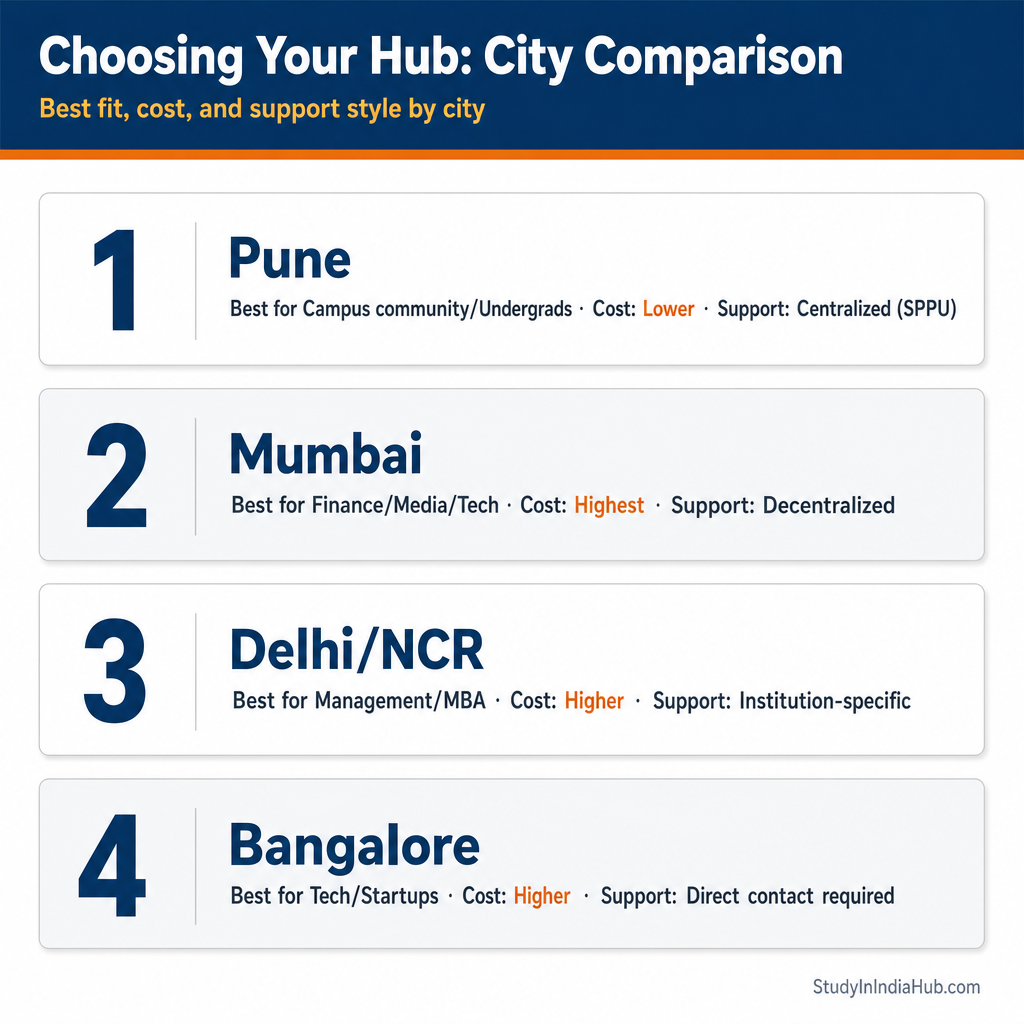
The city you choose influences your network and opportunities after graduation just as much as the university itself. This is a comparison of the four primary hubs.
Pune: The Student City
Pune is the primary place that most undergraduates and early master’s students should consider initially. The international group at SPPU represents the largest gathering of foreign students at any Indian university. The benefit is consolidation. The International Centre at SPPU manages admissions, accommodation, FRRO registration, and integration all in a single office. You aren't jumping between departments. Symbiosis International University attracts international students for its business and law programs. The city's primary air portal, Pune Airport (PNQ), ensures easy arrivals, and Pune is on the lower side of India's metro expense scale.
Mumbai: The Career Accelerator
Choose Mumbai if your focus is on internships, alumni connections, and industry opportunities in finance, media, and technology. The trade-off: at University of Mumbai, global assistance operates at the college and departmental level, rather than via a single central office. You'll handle more paperwork on your own. Verify your college's procedures from the start instead of relying on a helpdesk. Chhatrapati Shivaji Maharaj International Airport (BOM) serves as the access point, but anticipate increased rental prices in the airport vicinity.
Delhi/NCR and Bangalore
Delhi/NCR is the most robust choice for management education and institutional concentration. The area is home to leading MBA institutions such as the Indian Institute of Management Lucknow (Delhi campus), Management Development Institute, and International Management Institute (NIRF). For hospitality, CIHMs in Delhi and Mumbai provide fee reductions of up to 40% for international applicants (immitalks.com). Expenses are greater than in Pune. Bangalore is ideal for students in engineering, computer science, and tech entrepreneurship seeking immersion in startups. Cost and enrollment information at the campus level is not publicly available, so reach out to institutions directly prior to making a commitment.
| City | Best For | Cost Tier | Support Structure |
|---|---|---|---|
| Pune | Campus community, peer network | Lower | Centralized (SPPU Int'l Centre) |
| Mumbai | Finance/media/tech careers | Higher | Decentralized, college-level |
| Delhi/NCR | Management education, MBA | Higher | Institution-specific |
| Bangalore | Tech, engineering, startups | Higher | Verify directly |
[IMAGE PLACEHOLDER: Map of India highlighting the four main student hubs — Pune, Mumbai, Delhi/NCR, Bangalore]
Cost vs. Opportunity
Current yearly living costs range from $15,000 to $25,000, varying by city. Pune is positioned at the lower end. Mumbai, Delhi, and Bangalore are at the upper tier. Reduced expenses do not equate to reduced possibilities. It signifies various ones. And keep in mind: if your visa exceeds 180 days, the FRRO countdown begins as soon as you arrive. Pune's centralized system is a true benefit in this context.
What Students Actually Say
The victories students refer to are tangible. A Nigerian MBA student informed me that the 25% academic fee scholarship rendered the program economically feasible in ways a US degree could never match (DASA). A student from Kenya shared her experience with professors who required her to justify her ideas during seminars instead of merely lecturing. Her group included 15 countries and, according to her, was worth the trouble of obtaining a visa. In Pune, the SPPU group helps in locating peers who are familiar with the same documentation and classroom flow. Think of a typical Nigerian student we assisted during a two-year MBA program at a top private university in Pune. The expenses totaled approximately ₹16–18 lakh for tuition, along with around ₹1.2 lakh annually for shared accommodation and living costs. The overall amount approached ₹20 lakh (approximately $24,000) within the two-year span. The schedule was clear: arriving in July, two school years, and a final-semester internship that turned into a campus job. Upon graduating, the student obtained a position with an Indian IT services company at approximately ₹9 lakh per year. In three years, they stepped into a regional management role in West Africa. The friction is seldom what students anticipate. The most common complaint I hear is regarding deadlines. The deadline for the mid-July enrollment is April 15. The majority of institutions do not offer rolling admissions, so missing the deadline results in losing an entire year (Study in India). A student from Brazil invested three weeks handling paperwork prior to arrival, dealing with visa extensions, FRRO slowdowns, and documentation cycles. The SII portal is designed to be without identity and free of paper. However, you must remain proactive to ensure your Registration Permit arrives at your appropriate local address. Submit your application a minimum of 2 weeks ahead. Starting from the 2025–26 cycle, Nepali students are also required to register with the FRRO (Kodem Law).
Visa duration eases some pressure once you're in:
| Student | Visa Duration | Work Rights |
|---|---|---|
| Undergraduate | 4 years | None on student visa |
| Postgraduate | Course duration, max 5 years | None on student visa |
Final Verdict: Is India Right for You?
India does not have a universal solution. It is highly effective for certain students while being an incorrect choice for others. Here’s how to determine which group you belong to.Opt for India if you're mindful of your budget and dedicated to your profession. Your expenses will be a small portion of what you would incur in the US, UK, or Australia. You will also learn in the second-largest higher education system globally, featuring more than 800 universities. The ROI is substantial if your focus is on engineering, IT, management, or conventional sciences. It is also among the rare places for specialized areas such as Yoga, Vedic culture, or Indian classical music.Seek other options if you require guaranteed post-study employment. Work visas necessitate a gross yearly salary exceeding US$25,000 (ABriggs). The majority of entry-level positions for new graduates do not meet that standard, complicating visa conversion. If remaining after graduation is essential, Australia or Canada offer more straightforward paths.
Common Mistakes to Avoid
Studying in India can be a fulfilling experience. However, minor mistakes lead to loss of time, money, and increased stress for students. Here are the errors I repeatedly observe. Stay away from them, and your path becomes considerably easier.
Underestimating the Cultural and Practical Adjustment
Numerous international students come anticipating a seamless, ready-to-use experience. Reality strikes intensely. The cuisine, the weather, the daily rhythm, and the red tape can astound you during the initial month. Conduct your research prior to your arrival. Engage with fellow students from your country in campus organizations. Allocate additional time and funds for your adjustment, and you'll acclimate much more quickly.
Submitting Incomplete or Incorrect Documentation
Indian universities have strict rules regarding documentation. A single incorrect document can delay your entire application. Obtain your academic transcripts, passport, and financial documentation certified and translated precisely according to the university's specifications. Verify the format of every document, as specifications differ among states and organizations. Maintain both digital and physical versions of all materials. Ensure that the spelling of your name is consistent on all documents.
Missing a Critical Deadline
The process for admission and visas includes numerous deadlines. Not having even one can set you back an entire semester. Record each date as soon as you obtain it: application, fee payment, visa, and FRRO registration. Schedule reminders two weeks before each event. Do not take for granted that a grace period exists. In India, there's typically no provision, and late candidates frequently forfeit their spot.
Frequently Asked Questions
Q: Can I work while studying in India?
Work permits are stricter in comparison to other educational locations. The majority of student visas do not permit employment, either on-campus or off-campus. Your university might allow a few internships related to your program. Prior to making a commitment, inquire with your admissions office if paid employment is permitted, and verify it against your student visa requirements. If making money while studying is crucial, India may not be the best option.Q: What is the duration of my stay allowed after completing my degree?India does not have an official post-study work visa similar to that of the UK or Canada. You must go back home, apply for a different work visa (requiring a job offer), or continue your education. Prepare your financial strategy with the expectation that you will depart after your course concludes.
Q: What if my university isn't in global rankings?
Numerous Indian colleges are excluded from the prominent ranking systems. That doesn't imply low quality, but it does indicate reduced independent verification. Verify accreditation via the National Assessment and Accreditation Council (NAAC) and request alumni employment statistics from the institution.
Q: Can I transfer credits to another country afterward?
The policies of the receiving institution, not those of India, determine credit transfer. Certain universities recognize Indian credits, while others do not. Reach out to the university you plan to attend before enrolling and inquire if they accept degrees or credits from your selected institution. Avoid making assumptions about portability.Q: What occurs if I wish to prolong my visa?Extensions are processed by the Foreigners Regional Registration Office (FRRO) located in your city. They might happen, but it's not certain. You will require evidence of ongoing enrollment, financial stability, and a legitimate cause. Initiate the extension a minimum of 60 days prior to the expiration of your current visa, as timelines differ by location and FRRO workload.Q: What happens if my university alters after receiving the visa?It's an issue related to document changes, not a simple admin update. Typically, you will require the new offer letter, an amended visa support letter, and a current fee receipt. Students postpone their enrollment when they believe the previous visa aligns with the new acceptance.
Q: Are there scholarships specifically for international students?
The majority of scholarships from the Indian government focus on students from particular countries or areas. Visit the Ministry of External Affairs (MEA) website to find country-specific programs. University scholarships are available but are scarce and fiercely competitive, so investigate your school's international offerings promptly.
Q: What if I face discrimination or safety issues?
There are recorded instances of bias toward international students, particularly those hailing from African countries. First, report harassment to your university's international student office, and then to local police or FRRO if necessary. Create a network of fellow international students and maintain contact with your embassy.
About the Author
Dr. Meera Krishnan has dedicated five years to examining NAAC, NIRF, and QS rankings to assist international students in choosing the ideal Indian university for their aspirations. Having been a NAAC assessment consultant, she knows what the rankings truly evaluate and where their limitations lie.
How We Researched This Article
Every article undergoes fact-checking against original sources and is evaluated by educators with firsthand experience in international student admissions. We gather our information from official university sites, NAAC/NIRF databases, government visa portals, Numbeo cost-of-living statistics, and direct communication with university international student departments. Daily updates for exchange rates. Costs of living updated weekly. University information assessed every quarter. Based on our interactions with students from various universities in Pune, the centralized support system significantly impacts initial results. International student offices usually manage FRRO registration, housing, and academic onboarding from a single point of contact. Advisors we've consulted indicate that this significantly reduces the risk of first-semester dropouts, particularly for students unfamiliar with Indian bureaucracy. Students utilizing these offices acclimate more quickly than those who navigate independently. Converting a student visa to an employment visa is among the most challenging processes, yet it can be accomplished. Students we've collaborated with state that the primary challenge was reaching the minimum salary requirement, which is significantly higher than starting wages in numerous industries. Individuals who were successful typically secured positions in IT services, global consulting, or engineering companies that could validate the elevated salary range. The approach is straightforward: obtain a job offer from a reputable company that satisfies the salary criteria prior to your student visa's expiration, and initiate the documentation process promptly.
Sources
- IIT Bombay engineering ranking, NIRF 2024
- NIRF Overall Ranking 2024
- QS World University Rankings 2025
- immitalks.com
- Study in India Portal
- Study in India Onboarding & FRRO
- Indian students abroad, Wikipedia
- SPPU International Centre
- Embassy of India, Kathmandu
- AIU Equivalence Division
- NEP 2020
- VIT
- NAAC Accreditation Results
- Indian Visa Online
- Ministry of Home Affairs
- Indo Global
- Times Higher Education
- Indian Visa Online — processing
- DesiNRI
- IELTS
- educations.com
- indiainatlanta.gov.in
- eoivilnius.gov.in
- Wise — Hyderabad
- Numbeo — Pune
- Numbeo — Mumbai
- braingainmag.com
- indianvisaonline.gov.in
- alfabetaglobal.com
- SPPU's International Centre
- Symbiosis International University
- Pune Airport (PNQ)
- University of Mumbai
- NIRF
- DASA
- Kodem Law
- Employment visa salary requirement, EY
- ABriggs
- Ministry of External Affairs (MEA)