Is India Safe for International Students? Safety Guide 2026
By Arun Menon, Specialist in Education Finance | Most recent update: June 08, 2026
[IMAGE PLACEHOLDER: International students walking across an Indian university campus]
The Short Answer
India is generally secure for international students who remain alert and take wise precautions. However, safety differs significantly depending on the city, area, and daily routine. Among 800+ students from 40 nations, those who succeed view safety as a personal obligation, rather than as fearfulness. We have collaborated with recent immigrants from Nepal, Bangladesh, and Sri Lanka. The initial month seems daunting yet controllable. Students inform us that the timelines for paperwork, particularly FRRO registration, are what cause them stress, rather than safety concerns. Housing typically organizes within the initial two weeks after they link up with university housing units or reputable PG networks. The largest change is in local transportation: taxi fares, subway lines, and rideshare app conventions. The majority of students report that it feels habitual after a couple of weeks. According to the latest All India Survey on Higher Education (AISHE) data, India accommodates about 46,000 to 49,000 international students. Nepal holds the highest percentage at approximately 28%, with Afghanistan, Bangladesh, the United States, and the UAE next in line. The majority enroll in Karnataka, Maharashtra, and Punjab, states with established campus communities and extensive peer networks that facilitate the transition. Safety is influenced more by the city and institution than by the country overall. Top universities provide robust campus safety and well-established global communities. However, a student residing in a Symbiosis hostel in Pune experiences a different reality compared to someone renting solo in an unfamiliar area of Delhi.
What matters most is preparation before you arrive:
- Sign up on the SII portal and finish FRRO/FRRP registration within 14 days of arrival (Study in India).- Check the security measures of your university's campus and the hours for closing hostel gates.- Enroll with your embassy. Nepali students are now subject to particular registration regulations for the 2025-26 cycle (Embassy of India, Kathmandu). This guide addresses the authentic safety environment of 2026, neither overly cautious nor fearmongering (Study in India).
How India Compares to the UK, US, and Australia
The majority of safety concerns regarding India stem from perception rather than factual information. The learning process benefits those who organize their tasks based on documents and timelines. Avoid adopting assumptions from other nations.
[IMAGE PLACEHOLDER: Comparison infographic of student visa timelines across four countries]
The student visa process in India is quick. The new e-Student Visa typically takes 3 to 5 business days for processing. You require an acceptance letter from an accredited institution, evidence of financial resources, and a current passport. Contrast that with the rest.
| Country | Visa Type | Processing Time | Key Requirements |
|---|---|---|---|
| India | e-Student Visa | 3–5 working days | Admission letter, proof of funds, passport |
| UK | Student visa | ~3 weeks | Standard student requirements |
| Australia | Subclass 500 | 4–6 weeks | Genuine Student criteria, OSHC health cover |
| US | F-1 | Weeks to months | SEVIS registration, DS-160, embassy interview |
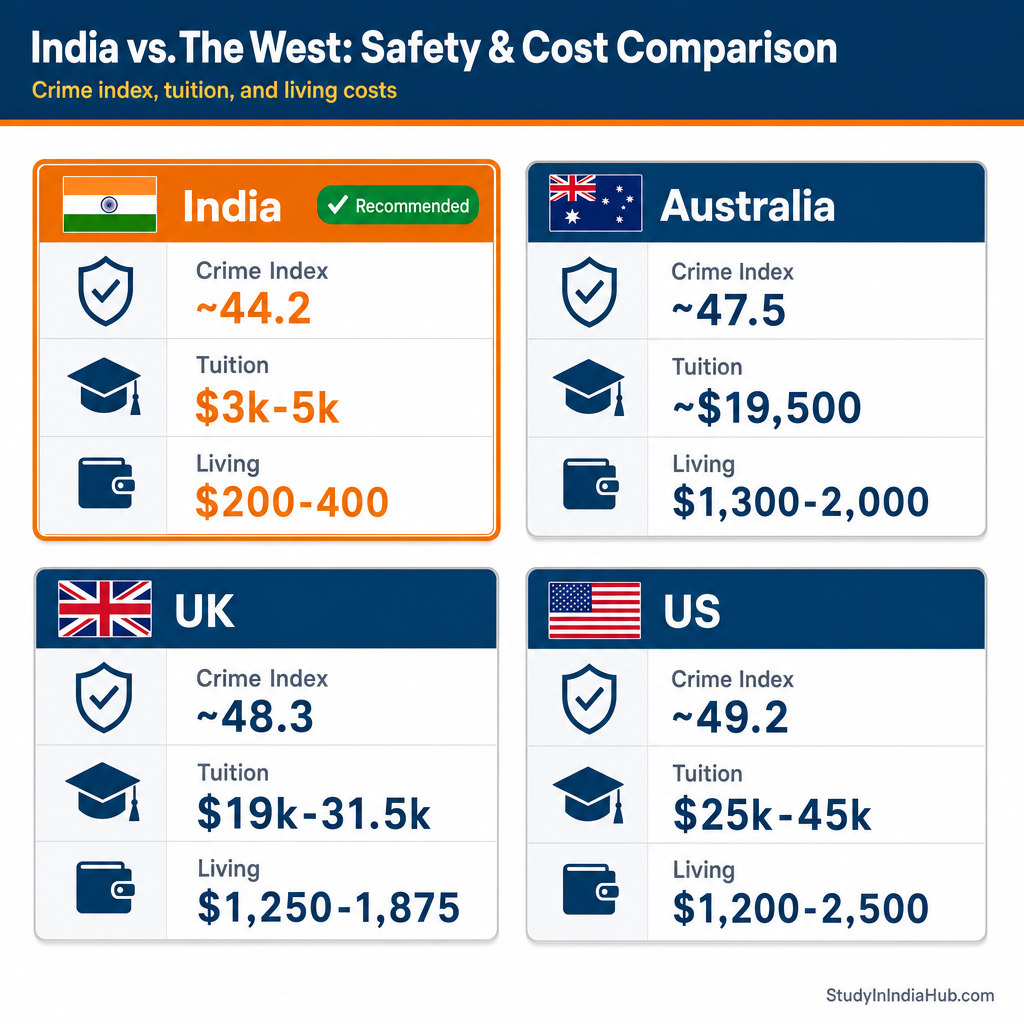
India's quicker processing and reduced paperwork are a significant benefit for students facing strict enrollment timelines. Begin with what can be confirmed. India operates the second-largest higher education system globally, comprising over 800 universities (Study in India). This provides you with more course and budget choices than many students anticipate. The S-1 student visa is based on documentation and does not require a formal interview. It's valid throughout your entire course, with no yearly renewal (Study in India). Research and PhD visas have no set limit on duration (IDP). The safety information is nearer than many anticipate. On the Numbeo scale, a score of 40–60 is considered moderate crime. India holds a Crime Index of roughly 44.2, firmly within that range (Data Pandas). Here’s the unexpected reveal. The Western locations people believe are safer actually rank lower:
| Country | Crime Index (Numbeo) |
|---|---|
| India | ~44.2 (lowest of the four) |
| Australia | ~47.5 |
| United Kingdom | ~48.3 |
| United States | ~49.2 |
Source: Data Pandas
The US murder rate is estimated to be around 4.0 per 100,000 in 2025 (Data Pandas). India's index ranks the lowest among the four, not the highest.
Cost: India Versus the West
India isn't less expensive due to its inferior quality. The higher education sector is subsidized by the Government of India. That's the reason Medicine and Pharmacy can cost less than US$1,000 annually. VIT estimates foreign-national B. Tech tuition at about US$3,000–5,000 each year (Study in India). Living expenses range from US$200–400 per month, significantly lower than the AUD 2,000–3,000 per month you would encounter in Australia.
| Factor | India | Australia | UK | US |
|---|---|---|---|---|
| Annual tuition (engineering) | US$3,000–5,000 | ~AUD 29,710 (~US$19,500) (IDP) | £15,000–25,000 (~US$19,000–31,500) | US$25,000–45,000 |
| Monthly living cost | US$200–400 | ~US$1,300–2,000 | ~US$1,250–1,875 | US$1,200–2,500 |
| Crime Index (Numbeo) | ~44.2 (moderate) | ~47.5 (moderate) | ~48.3 | ~49.2 |
| Student visa | No interview; valid for full course | Annual renewal | Annual financial proof | F-1 tied to full-time enrollment |
Crime Index source: Data Pandas
Where India Lags: Process Discipline
This is the genuine vulnerable point. Should your course extend beyond 180 days, you are required to register with the FRRO within 14 days of your initial arrival (Study in India). It's managerial, not monetary. However, I've observed students waste weeks considering it as non-essential. Students studying full-time are required to sign up on the Study in India (SII) Portal. It was jointly launched by the MoE, MEA, and MHA on 3 August 2023 (Study in India, immitalks.com).
Scholarship Reality
The Study in India Scholarship exists but is highly competitive. India provides greater government-supported financial aid to international students compared to Australia or the UK after Brexit (Study in India). By merging an ICCR scholarship with a merit award from the institution, you can address the majority of the fees. That framework is not present in the same way in the US or UK. Assess India based on expenses, paperwork requirements, and registration duration, rather than on presumptions. The figure on the website is rarely the actual figure. Verify hostel, registration, and transportation fees directly prior to making a commitment.
Safest Cities for Students: Mumbai, Pune, and Beyond
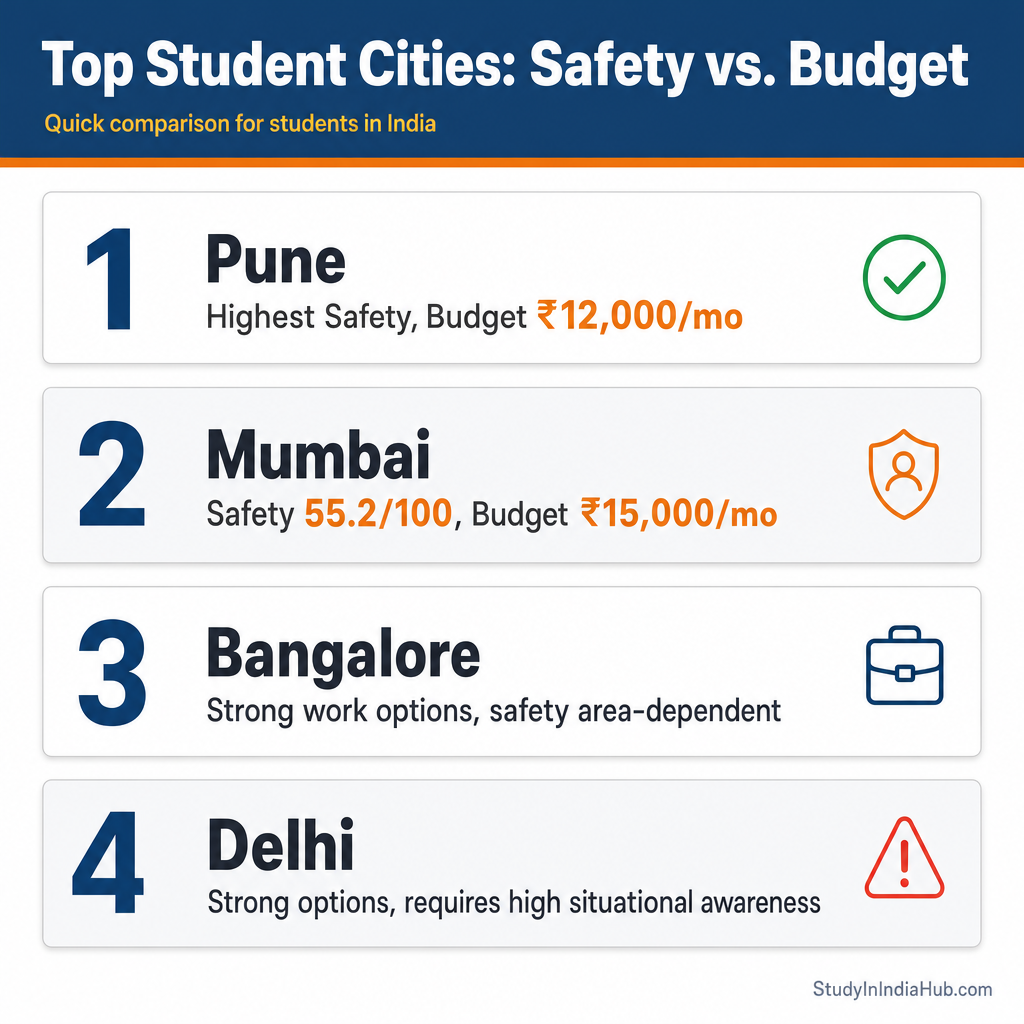
That guideline applies when selecting a city. The figure shown on the website does not accurately represent the true cost when you include secure housing and transportation.
[IMAGE PLACEHOLDER: Map of India highlighting major student cities]
Mumbai and Pune are preferred options for international students, featuring established safety records and promising employment opportunities (Alfabeta Global). A straightforward ranking remains consistent daily: Pune > Mumbai > Bangalore > Delhi.
| City | Safety Profile | Monthly Budget (Starting) | Primary Student Hubs |
|---|---|---|---|
| Pune | Higher than Mumbai; built around its student population | ₹12,000 (Numbeo) | Viman Nagar, Kothrud, Hinjewadi |
| Mumbai | ~55.2/100; workable if you stay organised | ₹15,000 (Numbeo) | South Mumbai, Powai, Vile Parle |
| Bangalore | Strong work options; safety depends on area | data not publicly available (Alfabeta Global) | — |
| Delhi | Strong options; be picky about locality | data not publicly available (Alfabeta Global) | — |
Mumbai vs Pune
Mumbai's safety score of approximately 55.2/100 indicates a city that is always awake. That affects both sides. Transport is available at 3:00 AM. However, the elevated expenses compel numerous students to seek more affordable, less safe areas on the outskirts. Students have opted for an ₹8,000 room in a remote suburb with inadequate lighting instead of a ₹15,000 shared apartment in a gated community, ultimately wasting 2 hours daily on commuting. Pune excels in affordability. It centers on its student community, so nearby businesses and drivers are accustomed to global residents. Reducing rent by ₹3,000 monthly in Pune instead of Mumbai significantly decreases your overall expenses.
Delhi and Bangalore
Both are key centers but require increased situational awareness. In Delhi, search for homes in "colonies" that have engaged Resident Welfare Associations (RWAs) overseeing gated access. Both maintain significance due to opportunity density, which is important if your program is connected to internships or part-time employment.
Cost Stack Beyond the Rent
City choice changes what tuition actually feels like:
- CIHMs provide tuition fee reductions of as much as 40% in metropolitan areas such as Delhi and Mumbai (NCHM).- The tuition fees for international students at NIT range from USD 4,000 to 6,000 annually (Study in India).- Living expenses at public universities range from INR 1,20,000 to 2,40,000 annually in large urban areas (Braingain Mag).- The ICCR Scholarship A2A Portal will be accessible from 27 February to 22 April 2026 for the academic year 2026–27 (Study in India).
Paperwork That Affects How You Settle In
- A long-term degree program secures a Student Visa valid for a maximum of 5 years or the duration of the course, whichever is shorter (uohyd.ac.in).- Lack of FRRO registration may lead to substantial fines or expulsion.- Bangladesh HSC and Nepal NEB +2 are considered equivalent to Indian 12th standard (uohyd.ac.in). Nationals of Nepal and Bhutan are typically not required to register with FRRO.
Women's Safety: What Female Students Should Know
In India, female students encounter genuine risks, but these are manageable and not exclusive to this nation. The safety of students is a global issue. The Indian government has officially documented assaults on Indian students overseas during 2020–2024 (mha.gov.in). A scoping study regarding student community safety in Melbourne examined 1,013 students, comprising 515 international and 498 domestic (vuir.vu.edu.au). What is important is identifying where the risk areas are. Students we've collaborated with identify the same three: packed public areas, solo travel at night, and dimly lit locations. City or institution-specific incident data isn’t available, so your personal planning is more crucial than your geographical area. On r/IndianStudents and large Facebook groups, women students talk about the same practical issues: traveling late at night, female-only PG housing, and which areas feel the safest near major universities. A common motif is the distinct favoritism for app-based taxi services instead of street cabs during nighttime. Numerous individuals discuss the route-sharing and SOS functions they depend on. Posters additionally suggest reaching out to upperclassmen or women's groups on campus prior to arriving. Local insights surpass standard alerts.
Transport: Where Most Students Feel Vulnerable
The largest disparity lies between scheduled trips and unexpected activities after sunset. Consider Uber and Ola as the go-to options for nighttime journeys. Ride-hailing applications are more secure than hailing cabs on the street (immitalks.com). Utilize the "Share Trip" function with a companion. In 2026, women's compartments on local trains and women-only bus seats are set to persist and may even grow (StudyInIndiaHub). Route-level availability is not made public. Verify the specific service prior to your trip.
| Safety Feature | Availability | Recommended Use |
|---|---|---|
| Women's train coaches | Major metros (Mumbai, Delhi) | Use during peak hours |
| Women-only bus seats | Most city fleets | Located at the front |
| Ride-sharing apps | Nationwide | Use "Share Trip" after dark |
Accommodation
Remain in locations with high student activity, well-lit main streets, and excellent transportation connections instead of secluded spots close to campus. Verify the specific blocks where students reside. Utilize your university's housing office, local student organizations, or the SPPU International Centre (SPPU International Centre). Select a hostel or PG that has a security guard available round the clock and maintains detailed entry records. Choose more affordable off-campus housing, and you might find yourself allocating a larger portion of your $15,000–$25,000 yearly living budget on private transportation and safe facilities (immitalks.com). Prior to submitting any deposit, request the residence-hall regulations, the night-entry policy, and the name of a contact person.
Support, Recourse, and Paperwork
Bigger universities possess more proven safety protocols. Inquire if the campus provides a late shuttle service, has security gates, and features a documented support channel for women. Should you face harassment, initially report it to your university's women's cell or grievance officer. Store emergency contacts: campus security, police (100), and your embassy assistance line. PhD and research scholars are permitted to bring dependents, providing personal assistance (idp.com). Take care of paperwork in advance to avoid last-minute errands by yourself. Submit your application through the Study in India platform at least 2 weeks beforehand after completing your registration (Study in India). Students in medicine and paramedicine must also obtain the Ministry of Health's No Objection Certificate. Sri Lankan candidates are required to present documents at the High Commission in Colombo (36–38 Galle Road, 0930–1300 hrs) starting from 03.11.2025, with a processing time of 13 days (Study in India Hub).
Campus Security and Accommodation Safety
Campus security typically outmatches that of an average off-campus apartment. Leading hostels provide round-the-clock monitored access, CCTV observation, safe campus perimeters, and a professional security staff. The specifics, rather than the brochure phrase "hostel available," are what mitigate risk upon arrival (Sandip University).
[IMAGE PLACEHOLDER: University hostel with security gate and CCTV]
Institutional security serves as the most dependable foundation. Savitribai Phule Pune University (SPPU) accommodates approximately 14,000 international students from over 102 nations. Its International Centre serves as a dedicated resource for admissions and safety assistance (SPPU). Verify if your institution provides on-campus accommodation prior to committing to a private lease. Terna Engineering College, for instance, accommodates 1800+ students (Terna Engineering College). If you leave campus, account for the safety surcharge. In Delhi, accommodations suitable for students cost ₹7,000–₹12,000 per month (NoBroker). An inexpensive room can negate the security benefit if it does not have security personnel or access restrictions.
| Feature | On-Campus Hostel | Private Rented Flat |
|---|---|---|
| Security Personnel | 24/7 gated entry | Varies, often daytime only |
| Surveillance | Integrated CCTV | Limited to building entrance |
| Emergency Response | International Student Cell | Local Police (112) |
| Cost (Delhi) | Included in fees | ₹7,000–₹12,000 |
Vet the Place Before You Pay
- Request photos of the real room and bathroom, rather than a stock image.2. Verify 24/7 security in writing, along with gate regulations, visitor guidelines, and night entry deadline.3. Inspect for CCTV at access points and hallways, not solely the campus entrance.4. Check the location on Google Maps and inquire about the distance from the academic building in metres.5. Utilize your personal email ID for every reservation and university correspondence (Study in India). That final point is more important than students realize. If confirmations are sent to a different email, you lose the necessary documentation for verification. Prior to your arrival, install 112 India, Raksha, or bSafe (Sandip University). First, send an email and make a phone inquiry. If the response mentions the hostel, security desk, and move-in procedure, it's a positive indication. If it just sends a brochure PDF, continue your search. Always inquire plainly, who takes care of housing complaints post 6 pm? An unclear response indicates a red flag.
Getting Around Safely: Transport and Daily Life
What we inform students: allocate ₹1,000–₹3,000 for daily transportation. Observe the loss that begins as soon as you depend on street hailing rather than scheduled rides (NoBroker). The additional ₹200 here and ₹300 there accumulates quickly as you travel across campus, to the market, and return after dark. We assist newcomers, yet the same preventable mistakes occur repeatedly during the initial month. Most can be easily resolved once you understand what to look for:- Neglecting FRRO registration, students with long-term visas frequently overlook the 14-day period, leading to future visa issues.- Venturing out solo during the night, depending on unregulated taxis or navigating unknown paths after sunset instead of utilizing app-based rides with trip-sharing features.- Failing to save emergency contacts, numerous individuals neglect to store 112 (national emergency), 100 (police), and their university helpline until it is necessary.- Holding substantial cash amounts, displaying money openly or storing all assets in a single location rather than utilizing cards and restricted cash.- Publicly revealing accommodation information, sharing hostel or apartment locations on social media, which eliminates a fundamental aspect of privacy.
Build your routine around two safe options first:
- Confirmed ride applications, reserve within the app to track the driver, vehicle, and fare.- Subway lines, established paths, set prices, no bargaining.- Unauthorized taxis, use as a last resort, and only when you can verify the rate and car prior to entering. The simplest errors occur in the first week, when you're fatigued and still unfamiliar with the route names or station exits. At SPPU, approximately 10,000 international students from more than 100 nations indicate that student travel patterns are already established (SPPU International Centre).
Intercity Travel
For extended journeys, airfares frequently appear more costly than they actually are. Certain India–Nepal routes operate as many as 70 flights each week via Air India, IndiGo, Nepal Airlines, and SpiceJet (Trip.com). An inexpensive bus ticket can become costly when factoring in delays, transfers, and luggage management. We've observed students saving on paper, only to spend it on taxis and missed connections.
Daily Habits
Road safety comes down to routine, not warnings:
- Only cross at designated locations when possible.- Ensure your bag is zipped in busy places.- Keep your passport at your place of stay unless you truly require it.
One Rule for Scholarship Students
Monitor transportation within the budget, not as an afterthought. The Atal Bihari Vajpayee General Scholarship Scheme offered approximately 630 positions in 2022-23 (Indian Embassy, Kathmandu). Assistance is competitive, and daily expenses still require monitoring even if tuition is partially funded. The straightforward guideline: if the ride is untraceable, unlicensed, or cannot be found on a recognized app, avoid it.
Health, Medical, and Cultural Adjustment
Health insurance is essential, and it is mandated by most universities. The yearly insurance for international students costs ₹15,000–₹30,000 (approximately $180–$360). Your plan must cover outpatient services, hospitalization, and emergency evacuation (Study in India Hub). Check what is included in your university's plan prior to your arrival. Gaps typically emerge only when an individual requires assistance. Students who self-insure often postpone treatment until a minor infection leads to a ₹50,000 hospital charge. Private hospitals in India comply with global standards. This is one reason healthcare travel is increasing there (Study in India Hub). However, access is not equal. In Mumbai and Pune, multispecialty hospitals are located 10–15 minutes away from campus. In smaller college towns, you might have to commute. Public hospitals are available but have lengthy wait times and language obstacles for those who do not speak Hindi. Prior to the beginning of classes, store your cashless hospital list, the policy PDF, and the insurance helpline number.
Hygiene and Water
- Consume only bottled or filtered water, as your stomach requires time to adapt to local bacteria.- Allocate ₹300–₹500/month for bottled water if there's no filter in your hostel.- Allow approximately 4–6 weeks before attempting street.
Common Mistakes to Avoid
Choosing a city or university based solely on rankings is a common mistake. Safety levels differ significantly among neighborhoods, even within a single city. Investigate the surrounding region, converse with current students, and review crime trends prior to making a decision. Errors in documentation can disrupt your whole application. Consistently provide certified copies of transcripts, passports, and financial documentation in the specific format demanded by each university. Verify name spellings in all documents. A minor inconsistency can cause visa delays or denials. Missing a deadline happens more often than you realize, and it can cost students an entire year. Outline all important dates: application periods, visa interviews, scholarship deadlines, and accommodation reservations. Create reminders two weeks in advance. Submit ahead of the deadline to avoid server failures and last-minute rush.
Frequently Asked Questions
What is the actual processing time for the student visa?Regular processing takes 5–15 business days (IDP). In the busiest intake months (June–August), I've observed it extend beyond 20 days. What counts is the submission of documents to your local Indian embassy or VFS center, not the timing of your online application. A Bangladeshi student I collaborated with waited in line 18 days due to the delayed arrival of their AIU equivalency certificate. Submit all materials 6 weeks prior to your course start date, not 3. Failing to do so may lead to missing orientation dates that certain universities require to confirm scholarship eligibility.
What if my AIU equivalency takes longer than expected?
The equivalency certificate from the All India University (AIU) is required for qualifications obtained outside India. It typically requires 5–7 business days. In July–August, I observed it last for 11 days. Your visa application cannot progress without it. Ask for it as soon as your admission letter comes. Inquire directly with your admissions team if they will submit it or if it's your responsibility.
Can I work while studying in India?
The S-1 student visa does not explicitly allow for work on or off-campus, and the official MHA policy is not publicly accessible. Consult with your university's international office and the FRRO prior to accepting any offer. Research assistantships or teaching fellowships included in your program exist in a legal gray area. Do not presume they are permitted without documented approval. In contrast, New Zealand permits a maximum of 25 hours each week starting in 2026 (IDP).Is it necessary for me to register with the FRRO upon arrival?Certainly, within 14 days of your arrival at the Foreigners Regional Registration Office in your city (FRRO guidelines). Carry your passport, visa, enrollment letter, accommodation proof, and a filled-out Form C. The process takes 1–2 hours. Failing to meet this deadline may result in penalties reaching ₹10,000 and difficulties in exiting.
Can my family visit me on a tourist visa?
Certainly, on a distinct tourist (B-2) visa. They are not included in your student visa. To remain beyond a typical tourist limit (usually 60 days), they request an extension via the FRRO in India.Which documents should I carry with me at all times?Bring your passport, visa document, and FRRO registration receipt. Officers may ask for these during standard inspections. Maintain electronic versions on your mobile device. Your acceptance letter and proof of accommodation can remain at your home.
What if I want to stay after graduation?
Your S-1 visa will expire on the date your course ends. No extensions will be granted automatically. Submit an application for a new category, employment (E-2) or further studies (S-1): 2 months prior to graduation with your employer or future institution.
How We Researched This Article
Each article is verified against original sources and assessed by education experts who have firsthand experience in the admissions of international students. Our information is sourced from official university sites, NAAC/NIRF repositories, government visa websites, Numbeo living cost statistics, and direct communication with university international student offices. Daily updates for exchange rates. Weekly updated living expenses. Quarterly review of university data.
Sources
- Study in India
- Embassy of India, Kathmandu
- Study in India
- IDP
- Data Pandas
- immitalks.com
- Alfabeta Global
- Numbeo — Pune
- Numbeo — Mumbai
- NCHM
- Study in India (alt)
- Braingain Mag
- uohyd.ac.in
- mha.gov.in
- vuir.vu.edu.au
- Study in India Hub
- SPPU International Centre
- Sandip University
- SPPU
- Terna Engineering College
- NoBroker
- Trip.com
- Indian Embassy, Kathmandu
- OJED
- Colleges Nepal
- NCHMCT
- FRRO guidelines