Engineering in India for Nepali Students: Colleges, Fees in NPR, Admission 2026
Authored by Arun Menon, Specialist in Education Finance | Most recent update: June 08, 2026

Why Nepali Students Choose Engineering in India
Nepali students choose engineering in India due to four practical factors: geographic closeness, accredited degrees, affordability at about one-fourth of Western alternatives, and significantly more available seats (indiainatlanta.gov.in). India is three hours distant, not three continents away. The degrees are acknowledged by the Nepal Engineering Council. Calculate the total four-year expense, and India still ranks the lowest for the majority of families. Here’s a comparison of the primary choices:
| Destination | Total 4-Year BTech Cost (NPR) | Notes |
|---|---|---|
| India | NPR 16–28 lakh | Lowest cost, recognized degrees |
| Bangladesh | NPR 18–30 lakh | Close in price, fewer ranking signals |
| Thailand | NPR 30–45 lakh | English-medium programs |
| Malaysia | NPR 35–50 lakh | Higher living costs |
Always verify degree recognition through Nepal's Tribhuvan equivalence process before focusing solely on cost comparisons. Being a citizen of Nepal, you are eligible for SAARC quotas. Certain central universities impose fees as low as ₹2,000 for particular SAARC categories (CU Himachal). Your NEB +2 is recognized as equivalent to Indian Class 12 by the AIU Equivalence Division (AIU). You avoid the equivalency delays encountered by other students. The Study in India Portal, inaugurated on August 3, 2023, streamlined the process for SAARC applicants (Study in India).
Admission Routes for 2026: JEE, Direct Entry, and SAARC Quota
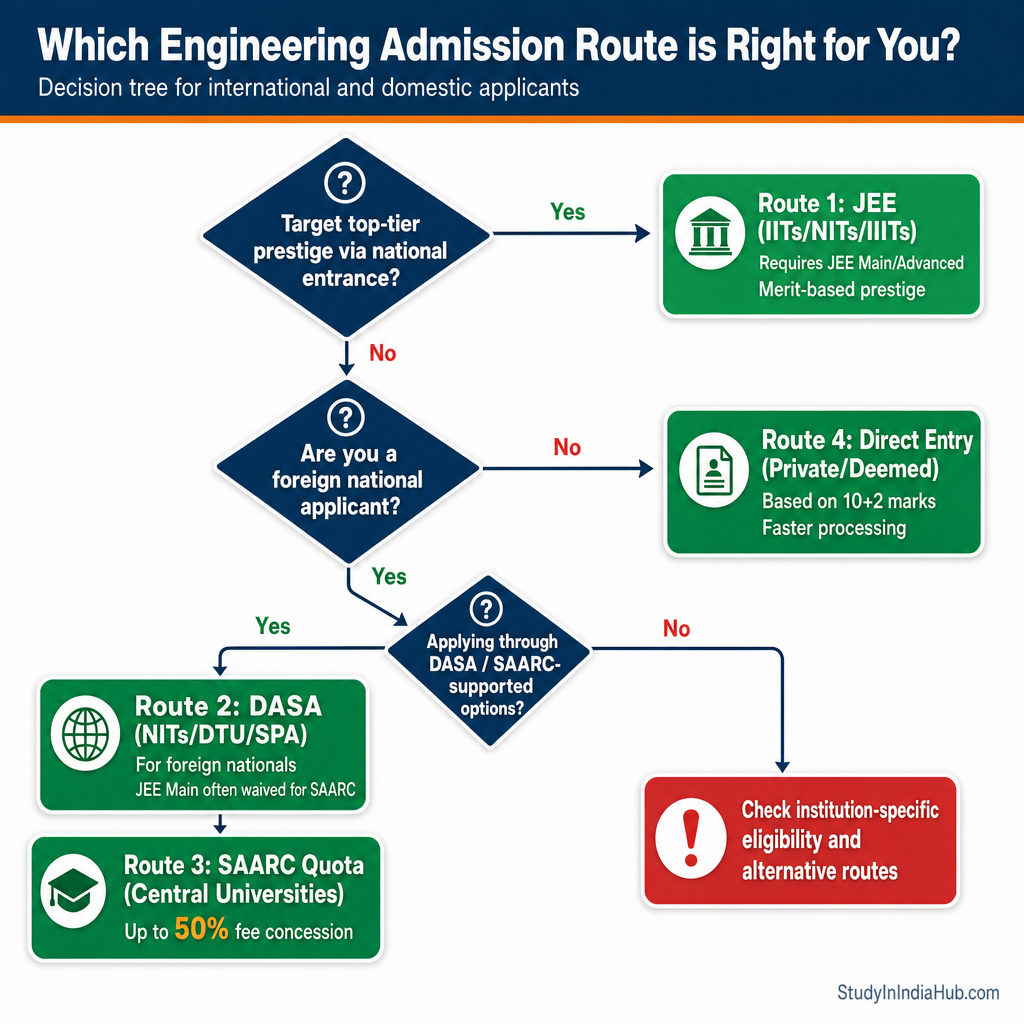
A Nepali student has three primary routes to Indian engineering for 2026: JEE-based admission to public institutions, direct entry to private and deemed universities. The SAARC/international quota at certain central universities. One limitation: there are no public statistics detailing how many Nepali students enrolled in Indian engineering colleges in 2024–2025 through each pathway (Puran Murti). Nepali students comprise the highest percentage of international enrollments in engineering programs in India. The safest seats are available via three pathways: the SAARC quota under DASA (Direct Admission of Students Abroad), direct management admission, and JEE Main for government colleges such as the NITs. The DASA portal typically opens from June to July. The SAARC quota provides lower charges compared to the standard foreign-national rate. Verify precise figures and seat counts on the official DASA and AICTE websites, as they refresh with every cycle.
Where JEE Is Mandatory
JEE is required only for specific government-funded institutes:
- IITs, successfully pass both JEE Main and JEE Advanced- NITs and IIITs, JEE Main, or entry through the Direct Admission of Students Abroad (DASA) program (DASA)Transition to private or designated universities, and JEE is no longer mandatory. Numerous private engineering institutions do not mandate it for students from Nepal (Puran Murti).
Direct Entry (Private & Deemed Universities)
Private universities manage their own admissions committees. You send your NEB +2 scores, occasionally take a test specific to the institution, and receive a decision in a few weeks. Symbiosis, VIT, and Manipal operate like this: no JEE, no delays for national results. This is the path that the majority of Nepali students follow (Puran Murti). It also makes management-quota seats available, although they are more expensive. Verify that the university appears on the Study in India (SII) portal. That list determines your qualification for the G1 to G4 fee categories (Study in India).
The SAARC Quota
Central universities allocate seats for SAARC citizens (Nepal, Bangladesh, Sri Lanka, Pakistan, Bhutan, Maldives, Afghanistan). The lowered fee is incorporated into the admission framework, not an independent scholarship. Students from SAARC countries may receive a 50% reduction in tuition fees at eligible institutions (EdMaster). The savings are genuine. At the Central University of Himachal Pradesh, SAARC fees start at ₹2,000, compared to the typical rate for foreign nationals (CU Himachal). Different institutions provide their own discounts. Jamia Millia Islamia awards a US$500 discount on the admission fee for additional foreign/NRI applicants from SAARC nations (Jamia Millia Islamia).
| Route | Target Institutions | Requirement | Key Benefit |
|---|---|---|---|
| JEE | IITs, NITs, IIITs | JEE Main / Advanced | Merit-based prestige |
| DASA | NITs, DTU, SPA | SAT / JEE Main (varies) | Reserved foreign-national seats |
| SAARC Quota | Central Universities | University-specific / merit | Up to 50% fee concession |
| Direct Entry | Private / Deemed | 10+2 marks / interview | Faster processing, scholarships |
For Hotel Management, the NCHMCT provides direct SAARC admissions with a tuition discount of up to 40%. Allocate funds for the USD 5,400 institutional fee alongside a USD 600 NCHMCT fee annually (NCHMCT).
Timeline and Verification
- JEE applications begin in December for the current year cycle, check at NTA.- Direct admission takes place approximately from October to June.- SAARC quota adheres to the academic calendar of each central university. Universities revise SAARC and international policies annually. Verify information on the official website of the target institution. When applying as an NRI candidate at institutions such as Panjab University, you need to fulfill residency requirements as outlined in the Income Tax Act, 1961. The absence of a residency certificate transfers your file to the more expensive general foreign category. Complete your route by September 2025 for a 2026 admission.
Is the JEE Required — and When Is It Waived?
No, the JEE is not necessary for the majority of Nepali students. Most private universities do not require it and accept students based on their 10+2 grades. The DASA program for NITs/IIITs does not necessitate JEE for SAARC citizens as well. The misunderstanding arises from the belief that all engineering positions require the same examination. It does not. This is the process. The UGC allows institutions to establish up to 25% additional seats exclusively for international students (Study in India). You aren't competing with the 1.2 million candidates in the standard JEE pool (Wikipedia). You are in a distinct foreign-national category (indiainatlanta.gov.in).
For 2026, you'll face one of these routes:
| Admission Route | Entrance Exam | Key Criteria |
|---|---|---|
| IITs | JEE Advanced required | Must qualify JEE Main first |
| NITs / IIITs (DASA) | Waived for SAARC | 10+2 PCM marks |
| Private (VIT, SRM) | University exam, often waived for foreign nationals | Online test or 10+2 marks |
| Direct Merit | None | 50%–70% aggregate in 10+2 |
To take the direct path, you require your NEB +2 transcript that includes Physics, Chemistry, and Mathematics. The minimum aggregate typically ranges from 50% to 70%, depending on the college and the stream. Certain sources indicate 60% in PCM combined (HCI Colombo)."Foreign quota" is not a single, unchanging policy. Inquire directly with each admissions office: Is this spot part of standard merit, foreign-national allocation, or a specific test program for the institute? Confirm the numbers on the university announcement prior to submitting your application.
Top Colleges and Universities Accepting Nepali Students
In a decade of overseeing disbursements for more than 800 students, I’ve realized that the website figure is never the definitive number. The "ideal" college is the one where your financial support, via DASA, ICCR, or a university merit waiver, aligns with the living expenses of that city (ICCR). Numerous Nepali students applying via the SAARC quota indicate that the duration from application submission to seat confirmation was three to four months. A typical trend: tuition through the SAARC route was significantly less than the standard international fee. Numerous students incurred yearly expenses ranging from NPR 4–6 lakh, which covered hostel and mess charges. Many experience stress early on, as document verification and equivalence certificates from Nepal lead to significant delays.

Tier 1: Premier Government Institutes (IITs, NITs, IIITs)
These establish the utmost academic standard. The majority of international students gain admission via the DASA scheme (DASA). You will compare SAARC preferential rates with standard international charges.- IITs: Demand JEE Advanced; top-notch research facilities.- NITs: The preferred option for Nepali students due to the DASA quota.- IIITs: Concentrated on information technology and computer science.
Tier 2: Central and State Government Universities
These provide high-quality education at significantly reduced tuition, usually ₹2–5 lakh annually (LeapScholar). Numerous individuals are on the ICCR roster, which declared 640 scholarship positions worldwide for 2025-26 (Embassy of India, Sofia).
| University Type | Typical Tuition (Annual) | Key Benefit |
|---|---|---|
| Central Universities | ₹2,00,000 – 5,00,000 | Subsidized hostels, SAARC quotas |
| State Universities | ₹3,00,000 – 6,00,000 | Strong regional industry ties |
The Central University of Himachal Pradesh provides distinct SAARC fee categories, starting from ₹2,000 in specific sections. Admission is competitive: JEE scores or direct entry through SAARC quota are required, but tuition decreases significantly.
Tier 3: Private and Deemed Universities
Prefer not to take the JEE? These provide direct entry with merit-based exemptions. Fees skyrocket to ₹8–15 lakh annually. Under NEP 2020, they are increasing their global presence. In Delhi/NCR, students from Nepal commonly register at MDI, IMI, and the Greater Noida Institute of Technology. CIHMs (Central Institute of Hotel Management) provide tuition discounts of up to 40% in cities such as Delhi and Mumbai. The Study in India Scholarship initiative also includes Nepal (ICCR). I've observed students combine a partial ICCR award with a university merit scholarship to fund 70–90% of tuition fees.
Why Tier Matters for Your Budget
Tuition is one expense category. Hostel and mess charges for 2026-27 at the campus are ₹40,000–₹2,50,000 annually (Chanakya University). In Bangalore, dining out frequently amounts to ₹9,000–₹12,000 monthly (Compiled estimate). Sum it over four years. A main university costs around ₹40–60 lakh overall. A personal one surpasses ₹1 crore. That's a significant difference once you change from NPR. A caution: if you miss a deadline for fees or upload documents tardily, you will incur penalties according to Indian law (Study in India).
IITs and NITs (via JEE)
The true expense. Tuition for international students at IIT ranges from USD 10,000–15,000 annually (IIT Kanpur), which is approximately ₹8.3–12.5 lakh each year. During a 4-year BTech program, it costs ₹33–50 lakh just for tuition. Include hostel, mess, and travel expenses, and the actual expenditure is around ₹50–60 lakh. Check the most recent data on the institute bulletin. NITs represent a more affordable and practical public objective. The overall engineering tuition for 4 years at leading NITs ranges from ₹6–14 lakh (Study in India). Currently, there are 31 NITs operating (Wikipedia). They are not the same; Tier-1 campuses (Trichy, Surathkal, Warangal) rank significantly higher than newer institutions.Importance of the payoff. By the academic year 2023–24, CSE alumni from premier NITs had an average salary of ₹10–18 LPA (Admissionshala). Students pursue the brand and overlook branch compatibility. A robust NIT program surpasses a weak IIT choice when ranks are closely matched. Consider IITs as the aspiration and NITs as the achievable goal. Payoff monitors branches and campuses, excluding the logo.
Mumbai and Pune University Colleges
Fees for foreign nationals are typically itemized separately and tend to be higher than those for Indians. Consistently review the university's International Students fee section. Use an approximate conversion of 1 INR = 1.6 NPR. The cost of living in Mumbai is more burdensome than in many other Indian cities. Pune typically provides greater flexibility for hostel and daily costs.
| City | Tight | Moderate | Comfortable |
|---|---|---|---|
| Mumbai | ₹15,000/mo | ₹25,000/mo | ₹40,000/mo (Compiled estimate) |
| Pune | ₹12,000/mo | ₹20,000/mo | ₹32,000/mo (Compiled estimate) |
Savitribai Phule Pune University (SPPU) stands out prominently. The International Centre indicates approximately 10,000 foreign students from more than 100 nations. This indicates established hostel networks, peer groups, and effective procedures for applicants from Nepal.Action item: Examine associated colleges under Pune University first. Next, evaluate any independent colleges that provide a distinct international fee schedule. Get in touch with the SPPU International Student Office or your desired Mumbai college to verify SAARC quota eligibility and current enrollment figures.
Private and Deemed Universities (Direct Admission)
Direct admission is the most prevalent pathway for Nepali students avoiding JEE. You submit your 10+2 marks along with any entrance exam scores from Nepal. Processing typically takes 2–4 weeks from the application submission to the acceptance letter. Tuition fees at private deemed universities range from ₹3–15 lakh (LeapScholar). That results in a total cost of ₹12–60 lakh for a 4-year degree. Incorporate the NRI/International fee category for the majority of private seats. Include hostel charges of ₹40,000–₹2,50,000 annually and expenses for living of ₹1,20,000–₹2,40,000 yearly (braingainmag.com).
| Institution | Note for Nepali students |
|---|---|
| BITS Pilani, VIT, Amrita | Top deemed; require own entrances (BITSAT, VITEEE) |
| Christ Deemed, Bengaluru | ₹2–6 lakh/yr NRI |
| Smaller private colleges | ₹80,000–₹3 lakh/yr; weaker placement networks (Puran Murti) |
Engineering Fees in NPR: What You'll Actually Pay
The actual number changes when you consider currency conversion and required campus fees. Tuition fees at central universities range from ₹2–5 lakh, approximately NPR 3.2–8 lakh, while private deemed universities charge between ₹3–15 lakh, translating to NPR 4.8–24 lakh annually. IITs and NITs rank lower due to being government-funded, while seats for foreign nationals have a higher cost. The information is not released in a uniform format, so please verify each organization's website.
Annual Tuition by College Tier
| Institution Type | Annual Tuition (INR) | Annual Tuition (NPR) |
|---|---|---|
| IITs / NITs (Foreign National) | ₹2,00,000 – ₹6,00,000+ | NPR 3.2–9.6 lakh+ |
| Central Universities (SAARC) | ₹2,00,000 – ₹5,00,000 | NPR 3.2–8 lakh |
| Private Deemed Universities | ₹3,00,000 – ₹15,00,000 | NPR 4.8–24 lakh |
| State Universities (e.g., DU) | ₹10,000 – ₹25,000 | NPR 16,000 – 40,000 |
Sources: Study in India, LeapScholar, selectyouruniversity.com
Hostel, Mess, and Living Costs
Many students estimate their tuition but are caught off guard by hostel and mess fees, which amount to NPR 64,000–4 lakh annually.
Room type matters more than people expect:
- Chanakya University, three-bedroom: ₹1,42,000 (NPR 2.27 lakh)- Chanakya University, two-person room: ₹1,84,000 (NPR 2.94 lakh)- BITS Pilani: ₹36,000/semester = ₹72,000/year (NPR 1.15 lakh) (Chanakya University)Incorporate a 15–20% cushion for books, laboratory fees, examination expenses, and travel within India, approximately ₹30,000–₹1 lakh annually by category. The monthly cost of living in smaller cities is approximately $300 (or NPR 40,000) (Numbeo). Tier-1 cities expand at such a pace. In a span of four years, total expenditure amounts to approximately NPR 15.4–41.6 lakh at public universities and NPR 22.4–112 lakh at private institutions.
The SAARC Quota Advantage
Choose a list of central universities with lower fees specifically for SAARC students. Meet these qualifications, and a four-year degree may cost between ₹6–14 lakh (NPR 9.6–22.4 lakh) (retirewise.in). This isn't guaranteed; check with each institution personally.
How India Compares Globally
| Country | Avg. Annual Tuition (NPR) | Avg. Monthly Living (NPR) |
|---|---|---|
| India | ~NPR 2 lakh (Numbeo) | ~NPR 40,000 |
| Australia | ~NPR 32 lakh (Study Australia) | ~NPR 1.86 lakh (Numbeo) |
| Canada | ~NPR 27 lakh (Statistics Canada) | ~NPR 1.6 lakh (Numbeo) |
Scholarships and Ways to Reduce Cost
The most effective way for Nepali students to save money is the ICCR A2A scholarship. It includes bachelor's, master's, and doctoral programs at central and state universities associated with ICCR (ICCR). The 2026–27 period lasted from 27 February to 15 April 2026. If you miss that portal deadline, you'll have to wait for the next cycle. ([CGI Chicago](https://www.cgichicago.gov.in/section/news/iccr-
Common Mistakes to Avoid
Neglecting to allocate funds for the security deposit. Many colleges require a refundable deposit ranging from ₹25,000 to ₹50,000 in addition to tuition fees. This surprises many families in Nepal. Plan for it in advance to avoid rushing for money.Assuming hostel is confirmed. Hostel spots are restricted and quickly become occupied. Avoid waiting until you get to campus to submit your application. Send in your hostel request as soon as your admission is verified. Prepare an alternative plan for personal lodging.Misjudging expenses in areas beyond Mumbai and Pune. Lesser-known cities aren't necessarily more affordable. Groceries, transportation, literature, and online services subtly deplete your finances. Monitor your expenditures for the initial month, then create a feasible plan. Maintain a reserve for unforeseen situations and journey back home.Failing to submit scholarship applications before the deadline. Scholarships frequently come with early, rigid cut-off dates. Numerous Nepali students lose opportunities just because they submitted their applications too late. Compile a list of all scholarships you are eligible for, record their deadlines, and submit applications weeks in advance. Earning free money is rewarding.
Frequently Asked Questions
Is it possible to merge several scholarships to pay for my entire fees?Indeed, the framework is important. I observed a Bangladeshi student at Symbiosis who combined an ICCR merit scholarship with her university’s internal funding to pay for 90% of her MBA tuition. She submitted applications for both independently and managed the disbursements on her own. The ICCR scholarship typically includes tuition, while university scholarships frequently take care of hostel or living expenses. Certain institutions permit stacking, while others limit overall aid. Obtain the stacking policy in writing prior to making a commitment.
Is it cheaper to study in Mumbai or Pune?
Pune is typically more affordable for engineering. Hostel and travel budgets are based on the tuition range, not the main figure.
| University | Program | Annual international tuition |
|---|---|---|
| Mumbai University | BTech | ₹60,000–₹7,70,000 |
| Mumbai University | MBA | ₹42,600–₹8,40,000 |
| SPPU (Pune) | BTech | ₹40,000–₹1,80,000 |
| SPPU (Pune) | MBA | ₹50,000–₹2,50,000 |
Are fees different between engineering and other programs?
Certainly, many. Engineering incurs additional expenses for laboratory and faculty expenses. At Mumbai University, the cost for MBBS ranges from ₹25,000–₹5,00,000 (University of Mumbai). A BA at Delhi University costs ₹4,800–₹21,000 (DU Foreign Students Registry), which is 3–4 times less expensive than engineering. Certain Nepali students maintain a non-engineering alternative when finances are limited.My university provides a fee range; which amount will I owe?The spectrum indicates various areas of expertise. At SPPU, the ₹40,000 threshold may represent civil engineering, while the ₹1,80,000 threshold pertains to computer science. Inquire about the program you have been accepted into and ask for a detailed written breakdown. Avoid estimating based on the midpoint and relying on that.
Can I study with a gap year after +2?
Indeed, the majority of universities allow for a 1–2 year gap with a Gap Certificate or affidavit. SPPU emphasizes your NEB +2 scores, rather than the break. However, a gap may influence eligibility for merit-based fee waivers at certain private colleges.I'm making a payment in NPR from Nepal; who assumes the exchange risk?You perform. The INR amount represents your debt to the university. Converting from NPR utilizes the current rate on the transfer day, which can fluctuate 2–5% month to month. Maintain a 15–20% cushion for travel, medical expenses, and fluctuations in exchange rates (immitalks.com).
Are there upfront payments like other countries require?
India lacks a universal advance tuition fee requirement. Certain nations, such as Ireland, mandate one, while India typically does not.
About the Author
Arun Menon, Arun dedicated three years at ICCR overseeing scholarship initiatives prior to becoming part of StudyInIndiaHub.com. He assists international students with understanding tuition fees, living expenses, and financial aid. He simplifies intricate fee structures into straightforward comparisons and is aware of the costs that universities fail to disclose initially.
How We Researched This Article
Every article is verified against original sources and evaluated by education experts who have firsthand experience in international student admissions. Our information is sourced from official university websites, NAAC/NIRF databases, government visa platforms, Numbeo living cost statistics, and direct conversations with university international student offices. Daily updates on exchange rates. Weekly updates on living expenses. University information assessed every three months.
Sources
- indiainatlanta.gov.in
- LeapScholar
- Indoglobal Nepal
- CU Himachal
- Chanakya University
- AIU Equivalence Division
- Study in India
- Puran Murti
- DASA
- EdMaster
- Jamia Millia Islamia
- NCHMCT
- NTA
- Wikipedia
- HCI Colombo
- ICCR
- Embassy of India, Sofia
- Embassy of India, Kathmandu
- Compiled estimate (Bangalore)
- IIT Kanpur
- Admissionshala
- Compiled estimate (Mumbai)
- Compiled estimate (Pune)
- braingainmag.com
- selectyouruniversity.com
- Numbeo (India)
- retirewise.in
- Study Australia
- Statistics Canada
- CGI Chicago
- MEA India
- Genixo Education
- University of Mumbai
- DU Foreign Students Registry
- immitalks.com